
Stainless Steel Investment Casting: Process, Benefits and Applications
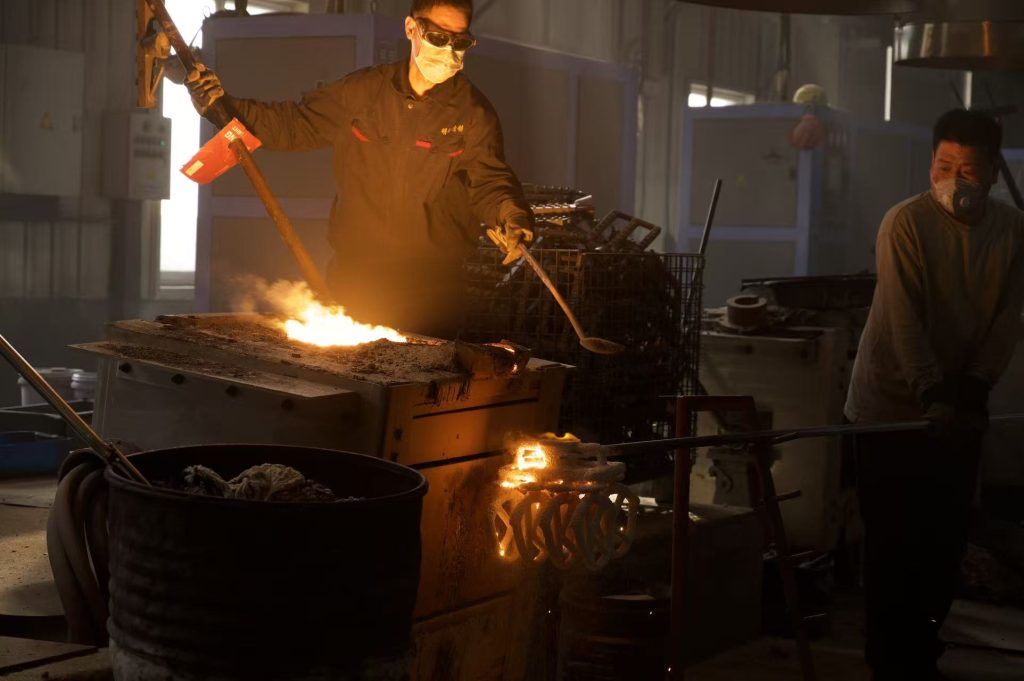
Introduction
Stainless steel investment casting is widely used to produce complex metal parts with excellent surface finish, high dimensional accuracy, and strong corrosion resistance. Compared with traditional machining or sand casting, this process can create intricate shapes while reducing material waste and machining costs.
At Aohai Investment Casting, we manufacture stainless steel investment castings for industries such as valve systems, pumps, machinery, automotive, and industrial equipment.
What Is Stainless Steel Investment Casting
Stainless steel investment casting, also known as lost wax casting, is a precision casting process used to manufacture detailed metal components.
The process begins with a wax pattern that is coated with ceramic shell layers. After the shell hardens, the wax is removed and molten stainless steel is poured into the cavity. Once cooled, the ceramic shell is removed to reveal the final casting.
This process is ideal for:
- Complex geometries
- Thin-wall components
- Smooth surface finishes
- Tight tolerances
- Medium to high production volumes
Stainless Steel Investment Casting Process
1. Mold Development
A precision mold is produced according to the product drawing. This mold is used to create wax patterns with accurate dimensions.
2. Wax Injection and Assembly
Wax patterns are injected and assembled into a tree structure. Multiple parts can be produced in one casting cycle.
3. Shell Building
The wax assembly is repeatedly dipped into ceramic slurry and coated with sand to build a strong shell.
4. Dewaxing
The wax is removed using high-temperature steam equipment, leaving a hollow ceramic mold.
5. Stainless Steel Pouring
Molten stainless steel is poured into the ceramic shell under controlled temperature conditions.
6. Shell Removal and Cutting
After cooling, the ceramic shell is removed. Individual parts are cut from the tree system.
7. Finishing and Inspection
Processes such as grinding, shot blasting, polishing, and dimensional inspection are completed before shipment.
Common Stainless Steel Grades Used in Investment Casting
304 Stainless Steel
304 stainless steel offers good corrosion resistance and is commonly used for general industrial applications.
Typical Applications
- Machinery parts
- Food equipment
- Hardware components
316 Stainless Steel
316 stainless steel provides better corrosion resistance, especially in marine and chemical environments.
Typical Applications
- Valve components
- Pump parts
- Marine equipment
CF8 and CF8M
CF8 is the casting equivalent of 304 stainless steel, while CF8M is similar to 316 stainless steel.
These materials are widely used in industrial valve and pump castings.
Benefits of Stainless Steel Investment Casting
Excellent Corrosion Resistance
Stainless steel performs well in humid, chemical, and high-temperature environments.
Complex Shapes with High Precision
Investment casting can produce complicated geometries that are difficult or expensive to machine.
Smooth Surface Finish
The process creates clean surfaces that reduce the need for extensive machining.
Reduced Material Waste
Compared with machining from solid metal, investment casting improves material utilization.
Consistent Product Quality
Modern automated equipment helps maintain stable quality and repeatable dimensions.
Industries Using Stainless Steel Investment Castings
Stainless steel castings are widely used in many industries.
Valve and Pump Industry
Precision cast stainless steel components are commonly used for valve bodies, impellers, and pipe fittings.
Automotive Industry
Automotive applications include exhaust components, brackets, and structural parts.
Food Processing Equipment
Stainless steel offers excellent hygiene and corrosion resistance for food-grade equipment.
Industrial Machinery
Many machinery systems require durable and wear-resistant stainless steel components.
Stainless Steel Investment Casting vs Machining
| Feature | Investment Casting | Machining |
|---|---|---|
| Complex Shapes | Excellent | Limited |
| Material Waste | Low | Higher |
| Surface Finish | Smooth | Depends on machining |
| Production Cost | Lower for batch production | Higher for complex parts |
| Dimensional Accuracy | High | Very high |
Investment casting is often more economical for complex parts and medium-to-large production quantities.
Surface Finish Options
After casting, stainless steel parts can receive additional surface treatments.
Common finishing options include:
- Shot blasting
- Grinding
- Mirror polishing
- Electro polishing
- Sand blasting
- Passivation
These treatments improve appearance, corrosion resistance, and product performance.
Why Choose Stainless Steel Investment Casting
Stainless steel investment casting combines precision, durability, and design flexibility. It is an ideal manufacturing solution for complex components requiring high strength and corrosion resistance.
With modern automated production systems and strict quality control, investment casting manufacturers can supply reliable stainless steel components for demanding industrial applications.
FAQ
What is stainless steel investment casting used for?
It is used for manufacturing complex metal parts in industries such as valves, pumps, automotive, food equipment, and machinery.
What is the difference between CF8 and CF8M?
CF8 is similar to 304 stainless steel, while CF8M is similar to 316 stainless steel and offers better corrosion resistance.
Can stainless steel investment castings be machined?
Yes. Investment castings can receive additional machining for threads, critical tolerances, or sealing surfaces.
Is investment casting better than sand casting?
Investment casting provides better surface finish, tighter tolerances, and more complex shapes than sand casting.
What surface finish can investment casting achieve?
Investment casting typically provides a smoother surface finish than many traditional casting methods, reducing the need for extensive polishing or machining.