Investment Casting vs Die Casting

Choosing between investment casting and die casting is crucial for manufacturers aiming to balance precision, cost, and production efficiency.

Both processes are widely used in metal manufacturing, but they serve different applications depending on design complexity and production volume.

What is Investment Casting?

Investment casting, also known as lost wax casting, is a precision manufacturing process that produces complex parts with excellent surface finish and tight tolerances.

It is ideal for components that require high accuracy and intricate geometry.

Learn more about our investment casting process.

What is Die Casting?

Die casting is a high-pressure process where molten metal is injected into a steel mold.

It is commonly used for high-volume production and offers fast cycle times with consistent results.

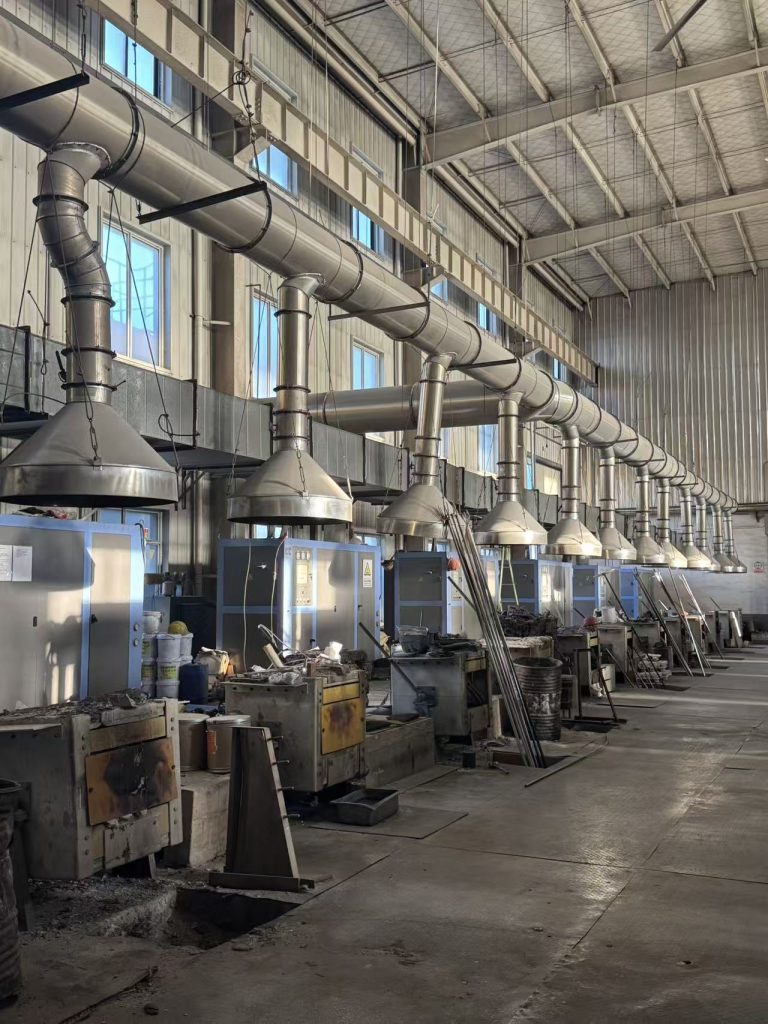
multiple melting furnaces for high capacity investment casting production
Equipped with multiple melting furnaces to ensure stable production and material consistency.

Key Differences Between Investment Casting and Die Casting

FactorInvestment CastingDie Casting
PrecisionVery highHigh
Surface FinishExcellentGood
ComplexityComplex shapesModerate
Production VolumeLow to mediumHigh
CostMediumLow (high volume)
MaterialsSteel, stainless steel, alloysAluminum, zinc
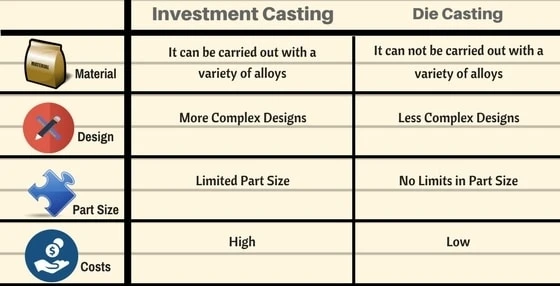
comparison of investment casting vs die casting process and differences
This chart highlights the key differences between investment casting and die casting in terms of precision, cost, and applications.

Advantages of Investment Casting

  • Ideal for complex geometries
  • Excellent surface finish
  • Wide range of materials
  • Reduced machining requirements

Advantages of Die Casting

  • High production efficiency
  • Lower cost in large volumes
  • Consistent quality
  • Suitable for lightweight materials

Which Process Should You Choose?

If your project requires high precision, complex design, and material flexibility, investment casting is the better option.

If you need high-volume production with lower cost and faster production cycles, die casting is more suitable.

Conclusion

Investment casting and die casting each have unique advantages. Understanding their differences helps you choose the most suitable process for your project. Understanding the differences between investment casting vs die casting helps you choose the right process.

Contact us to find the best casting solution for your application.

FAQ

Q1: What is the difference between investment casting and die casting?

Investment casting offers higher precision and complex shapes, while die casting is better for high-volume production.


Q2: Which is cheaper, die casting or investment casting?

Die casting is cheaper for large production volumes, while investment casting is more flexible for smaller batches.

Leave a Comment

Your email address will not be published. Required fields are marked *

Scroll to Top